In real-world vehicle operation, wheel bearing issues rarely announce themselves loudly at first.
More often, it starts quietly—a low hum at highway speed, a steering vibration that wasn’t there last month, or a subtle sense that the car no longer feels planted in long curves.
From an engineering standpoint, these are not minor annoyances. They are early indicators of load imbalance, internal wear, or loss of bearing integrity.
Wheel bearings operate at the center of the wheel-end system. They carry vehicle weight, absorb road shock, and maintain stable rotation mile after mile. When early warning signs are ignored, the consequences can escalate quickly—brake performance changes, ABS faults, wheel lock-up, or in extreme cases, wheel separation.
From the engineering perspective at SUMATE (Suzhou Jiuneng Automotive Technology Co., Ltd.), wheel bearing and wheel-end issues are rarely isolated failures. In most cases, they reflect accumulated load, installation accuracy, and real-world operating conditions interacting over time. Understanding what causes wheel bearings to fail—and how those failures first appear—helps prevent wider system damage and safety risks.
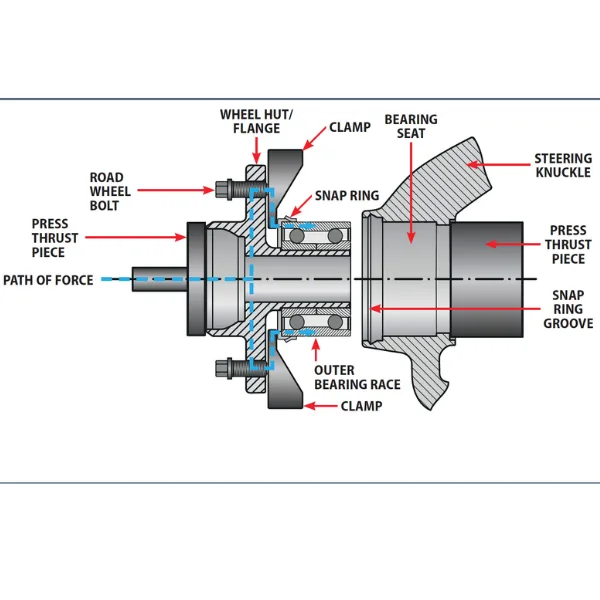
A wheel bearing is a precision assembly of hardened steel balls or tapered rollers, retained by inner and outer races and installed inside the wheel hub.
Functionally, it forms the mechanical interface between the rotating wheel and the stationary axle.
In practical driving terms, a wheel bearing is responsible for three critical tasks:
Allowing the wheel to rotate smoothly with minimal resistance
Supporting both static vehicle weight and dynamic loads
Managing forces generated by acceleration, braking, and cornering
Unlike engine bearings, wheel bearings do not receive continuous lubrication. Most modern vehicles rely on sealed, maintenance-free hub assemblies, often integrating the bearing, mounting flange, and wheel speed sensor into a single unit.
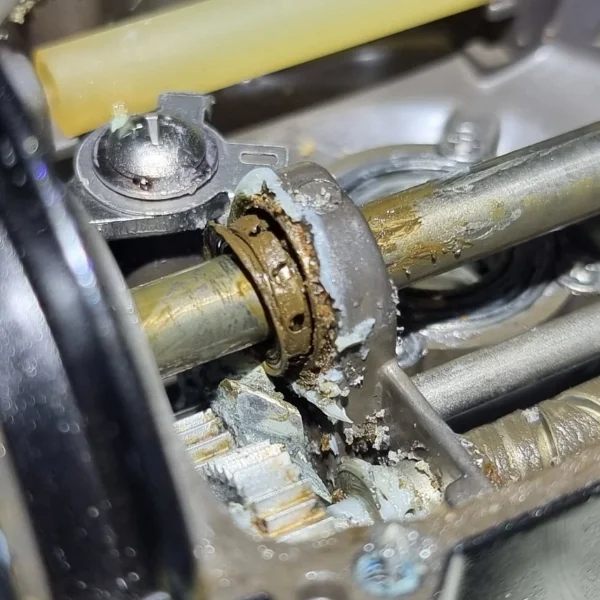
This design improves packaging and service efficiency—but it also means that once internal wear or contamination begins, replacement is the only reliable solution.

Based on SUMATE’s experience supplying wheel-end components for trucks, buses, passenger vehicles, and construction equipment, wheel bearing failures are rarely caused by a single factor. In real applications, most failures result from cumulative stress acting over time.
Even with proper sealing and material quality, wheel bearings are wear components.
After extended service—commonly between 80,000 and 150,000 kilometers—metal fatigue and grease degradation become unavoidable.
Mileage alone does not cause failure, but it reduces tolerance. As internal clearances increase, the bearing becomes more sensitive to load variation and impact.
Seal integrity is critical to bearing life.
Once water, dust, or road salt enters the bearing, lubrication quality degrades rapidly. Contaminated grease leads to surface pitting, corrosion, and accelerated wear of rolling elements and races.
Vehicles frequently operated in wet, muddy, or winter-treated environments consistently show shorter bearing service life in field data.
Road conditions play a major role in durability.
Repeated sharp impacts from potholes, uneven pavement, or aggressive speed bumps introduce localized shock loads into the hub. Over time, these impacts create microscopic damage inside the bearing that later manifests as noise and vibration.
From a manufacturing perspective, many early wheel bearing failures are not material-related, but installation-related.
Common contributors include:
Improper press-in alignment
Applying impact force instead of controlled pressing
Reusing worn fasteners or hardware
Incorrect hub nut torque
Excessive torque compresses bearing races. Insufficient torque allows movement. Both conditions dramatically shorten service life.
Wheel bearings do not operate in isolation.
Unbalanced or damaged tires introduce continuous vibration. Worn shocks or control arms allow more road force to pass directly into the hub. Chronic overloading pushes the bearing beyond its intended design limits.
In real-world use, these system-level issues often accelerate bearing wear long before the bearing itself reaches its nominal lifespan.
Direct impacts—such as curb strikes or deep potholes—can deform the hub or damage bearing races instantly.
Even when no visible damage is present, internal distortion may already compromise long-term reliability.
Noise is typically the first noticeable symptom.
Common descriptions include humming, droning, growling, or a low rumble that increases with speed.
Two characteristics matter most:
Noise intensity rises with vehicle speed
Tone changes during cornering
During turns, load shifts from one side of the vehicle to the other. If the noise becomes louder in one direction, the bearing on the opposite side is usually carrying increased load—and nearing failure.
As internal wear progresses, vibration may be felt through the steering wheel, especially at highway speeds.
This vibration can resemble tire imbalance, but often appears intermittently and changes with load, speed, or road surface.
Increased internal clearance reduces wheel-end stability.
Drivers may notice delayed steering response, reduced confidence during lane changes, or a subtle tendency for the vehicle to drift on straight roads.
From a system standpoint, the wheel is no longer being held in a consistently stable rotation path.
A worn bearing allows slight wheel tilt under load.
This leads to accelerated or irregular tire wear, often on a single wheel or axle. Alignment adjustments alone will not resolve the issue until bearing integrity is restored.
Bearing wear also affects braking performance.
Excessive hub movement can alter brake caliper geometry, leading to inconsistent pedal feel or reduced braking efficiency. On modern vehicles, excessive play can also interfere with wheel speed sensor readings, triggering ABS or stability control warnings.
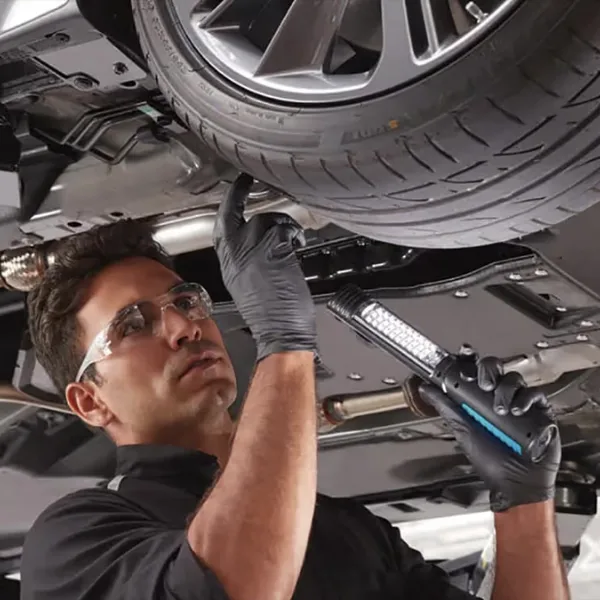
With the vehicle safely lifted, physical inspection often confirms advanced wear.
Noticeable movement when rocking the wheel at the 12 and 6 o’clock positions, or rough resistance when spinning the wheel by hand, indicates internal bearing damage.

These checks help identify potential issues, but they do not replace professional diagnosis.
Always work on level ground, set the parking brake, and support the vehicle with proper jack stands.
Check for lateral movement by rocking the wheel vertically.
With assistance, slow vehicle movement and careful listening near each wheel area may reveal abnormal sounds.
After a short drive, comparing hub temperatures can indicate excessive internal friction.
Important note:
These methods provide indications only. Final diagnosis should always be performed by trained technicians using proper tools and road testing.
No. From a safety and reliability standpoint, continued driving is not recommended. Once noise or play develops, wear can accelerate rapidly, increasing the risk of brake issues, overheating, or wheel lock-up. Driving should be limited until inspection and repair are completed.
The earliest sign is usually a low humming or growling noise that changes with vehicle speed. The sound often becomes more noticeable during turns as load shifts, followed by vibration or subtle steering changes as wear progresses.
Typical signs include speed-related noise, steering vibration, uneven tire wear, and noticeable looseness during physical inspection. Noise that changes when turning left or right is a strong indicator of bearing-related wear.
Seal failure is the most common root cause. Once contaminants enter the bearing, lubrication breaks down and internal surfaces wear rapidly. High mileage, improper installation, and repeated road impacts often accelerate this process.
There is no fixed timeline. Noise indicates internal damage has already begun, and failure progression depends on load, speed, and driving conditions. In many cases, deterioration accelerates unpredictably.
Often, only the failed bearing requires replacement. However, on high-mileage vehicles or after impact damage, replacing both bearings on the same axle may improve balance and long-term reliability.
Costs vary by vehicle design and labor rates. Sealed hub assemblies cost more than serviceable bearings, but quality components help prevent repeat failures and additional system damage.
Older tapered roller bearings can be cleaned and repacked. Most modern sealed hub assemblies are maintenance-free and must be replaced once worn or noisy.
No. A properly installed bearing should operate quietly. Noise after installation usually indicates incorrect installation, improper torque, or part mismatch and should be inspected immediately.
From a durability and reliability standpoint, wheel bearing failure is progressive—but the consequences can be sudden.
Noise, vibration, and steering changes are early system warnings. Addressing them early protects tires, brakes, suspension components, and overall vehicle safety.
At SUMATE, our focus has always been on durability, correct fitment, and long-term reliability in real operating conditions. In wheel-end systems, it is not marketing claims that prevent failures—it is sound engineering, proper installation, and components built to withstand real-world loads.