Facebook

WELCOME TO OUR BLOG

We're sharing knowledge in the areas which fascinate us the most
click

Automotive Belts: Types of Car Belts and Their Roles

By Lucas January 2nd, 2026 224 views

Why Engine Belts Matter More Than Most Failures Admit

Engine belts are not supporting actors. They are load-bearing components that transfer crankshaft power to systems the engine cannot run without.

When a belt slips or fails, accessories stop immediately. Charging drops, cooling suffers, and steering effort spikes. In timing-driven engines, the consequences escalate fast. Modern materials have extended belt life, but heat, load, and tension still decide how long a belt survives in real service.

In high-mileage vehicles, fleet applications, or commercial duty cycles, belt failures rarely happen in isolation. They show up as system problems—and treating them as single-part issues is how comebacks start.

The Belt Systems You’re Actually Relying On

Timing Belts: Where Small Errors Turn Into Big Damage
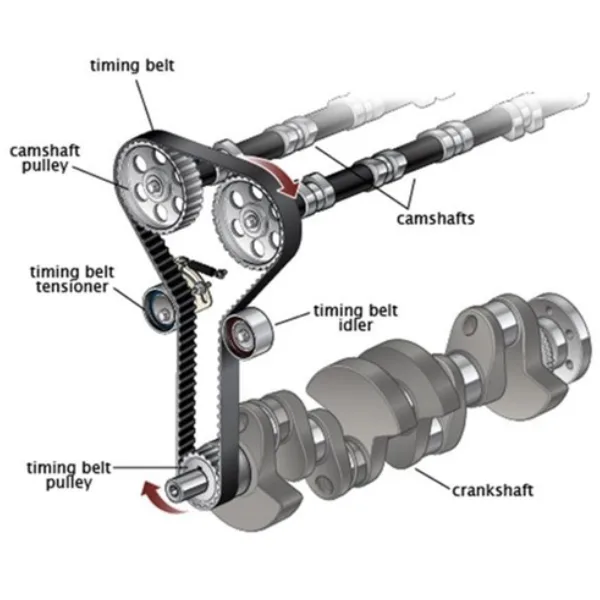
Timing belt diagram showing camshaft and crankshaft synchronization

The timing belt synchronizes crankshaft and camshaft rotation so valves open and close exactly when they should. This relationship is not forgiving. One skipped tooth changes combustion timing. Complete failure can end the engine.

A timing belt is a reinforced rubber belt with precision teeth that mesh directly with crank and cam sprockets. It runs behind the timing cover at the front of the engine, protected from debris but constantly exposed to heat cycles.

Service life typically falls between 60,000 and 100,000 miles, depending on engine design and operating load.

If the water pump is driven by the timing belt, replacing only the belt is false economy—especially in fleet or high-mileage use. Both components age under the same heat and load. Leaving an old pump in place raises the odds of a coolant leak or bearing failure that takes the new belt with it.

On interference engines, a broken timing belt allows pistons and valves to collide. At that point, you’re no longer talking about maintenance—you’re talking about engine damage.

Serpentine Belts: One Belt, Multiple Failure Points
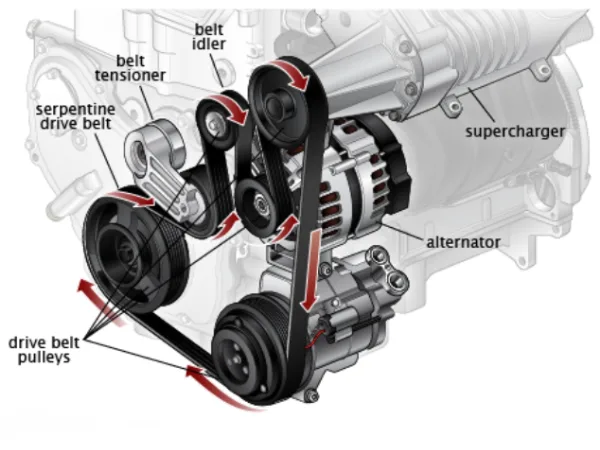
Serpentine belt routing diagram showing alternator, A/C, and power steering drive

The serpentine belt drives multiple accessories at once, including the alternator, power steering pump, A/C compressor, and often the water pump.

Its ribbed design increases contact area and grip, reducing slip compared to older V-belt systems. On paper, it looks simple. In practice, it works only as well as the components controlling it.

When serpentine belt issues show up, the belt itself is often not the root cause. Worn tensioners, weak springs, or misaligned pulleys allow the belt to slip, glaze, or chirp long before the rubber is actually worn out.

Typical service life ranges from 50,000 to 100,000 miles, but that number drops fast under sustained load, frequent cold starts, or marginal tension control.

Replacing a serpentine belt without addressing a borderline tensioner is how noise complaints return. In commercial vehicles or fleet service, belt and tensioner should be evaluated—and often replaced—as a matched system, not individual line items.

V-Belts: Why Older Designs Slipped Out of Modern Engines
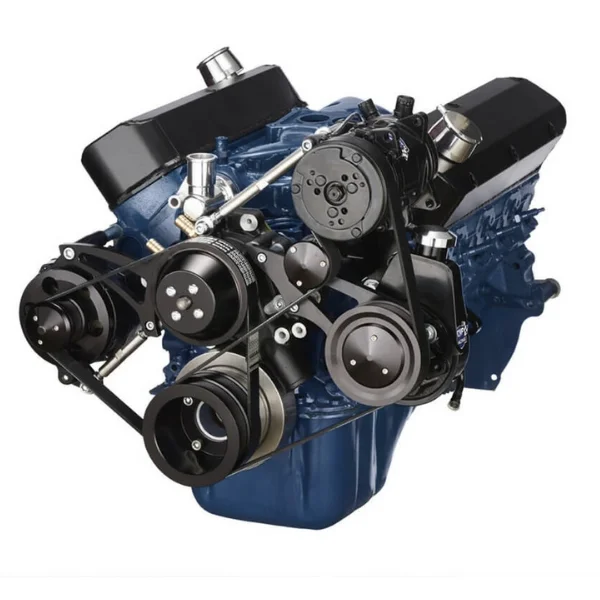
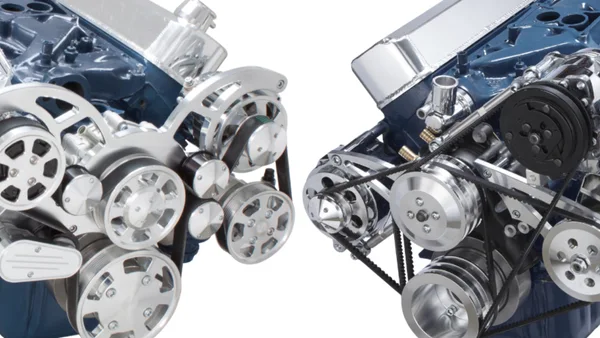
Comparison of V-belt and serpentine belt designs in automotive engines

V-belts were once standard for driving single accessories such as alternators or water pumps. Their wedge-shaped profile relies entirely on friction against pulley walls to transmit torque.

That design makes them sensitive to tension and alignment. Under high load or rapid acceleration, slip and wear accelerate. Manual adjustment and shorter service life made them increasingly impractical as engine bays became tighter.

With typical service life in the 40,000–70,000-mile range and higher maintenance demands, V-belts were gradually replaced by serpentine systems that reduced parts count and improved reliability.

Alternator Drive: Why Most Modern Cars No Longer Use a Separate Belt

In modern engines, alternator drive is handled by the serpentine belt rather than a dedicated alternator belt.

Failure symptoms haven’t changed—battery warning lights, dimming headlights, unstable voltage—but in modern systems these issues often trace back to belt tension control rather than the belt alone.

Timing Chains: Longer Life, Different Trade-Offs

Timing chains perform the same synchronization role as timing belts but use metal links instead of reinforced rubber.

They typically last longer and may be designed to last the life of the engine, but they add weight, generate more noise, and cost more to repair if failure occurs. Timing chains still rely on oil quality and tensioner integrity. They are not immune to wear—just slower to show it.

How Materials and Tension Control Changed Belt Reliability

Older belts were made from neoprene rubber reinforced with cotton or Kevlar cords. Modern belts use EPDM rubber, which resists heat, cracking, and stretch far better. Under proper conditions, service life can exceed 160,000 kilometers.

Design evolution mattered just as much. Multiple V-belts gave way to a single serpentine belt. Narrow profiles were replaced by wide ribbed designs. Manual tension adjustment was replaced by automatic spring or hydraulic tensioners.

Reliability improved—but dependence on proper tension control increased.

Inspecting Belts Before They Create Comebacks
Serpentine belt tensioner showing pulley wear and tension control mechanism

What Technicians Hear and Feel Before a Belt Fails

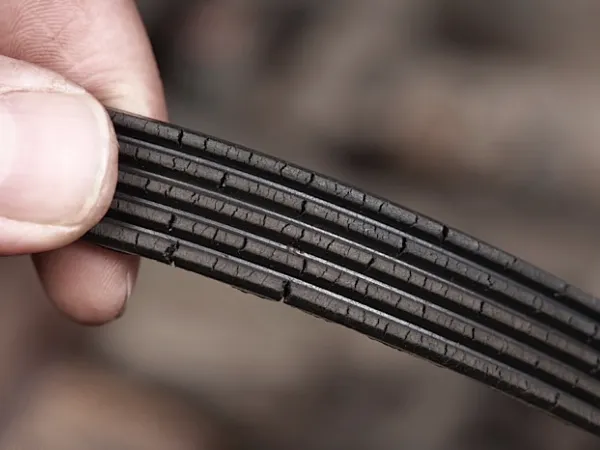
Cold-start squeal, persistent chirping under load, or slapping at idle often show up before visual damage. Glazed ribs, edge wear, or belt dust point to slip, not always belt wear.

Accessory performance tells the same story. Weak A/C output, heavy steering feel, charging instability, or creeping engine temperature usually reflect a system losing tension control.

Noise alone is not a diagnosis. In many cases, the belt is reacting to a failing tensioner or pulley, not causing the problem.
Worn serpentine belt with cracks and glazing showing common failure symptoms

Service Intervals That Actually Prevent Breakdowns

Belts should be inspected every 10,000–15,000 miles or at each oil change.

Typical replacement guidance places serpentine belts at 60,000–100,000 miles, timing belts at 90,000–110,000 miles, and V-belts at 40,000–70,000 miles. In fleet or heavy-duty applications, shorter intervals are often justified due to sustained load and heat exposure.

What’s Safe to Handle — and What Shouldn’t Be Rushed

Accessory belts can often be replaced with basic tools when access is straightforward and routing is clear.

Timing belt service should not be rushed. Precision matters. One misstep can undo an entire engine.

FAQ

How many belts does a modern vehicle have?
Most modern vehicles use one serpentine belt to drive accessories and either a timing belt or a timing chain for engine timing. Older vehicles may use multiple V-belts, each driving a single component. The exact number depends on engine design and vehicle age.

What’s the difference between a serpentine belt and a timing belt?
A serpentine belt drives external accessories like the alternator, A/C compressor, and power steering pump. A timing belt controls internal engine timing by synchronizing the crankshaft and camshaft. One supports vehicle systems; the other protects engine operation.

What are the main types of belts used in cars?
Most vehicles use a serpentine belt for accessories and either a timing belt or timing chain for engine timing. Older vehicles may also use V-belts to drive individual components. Modern designs favor serpentine systems to reduce parts and improve reliability.

What happens if a belt breaks while driving?
If a serpentine belt fails, accessories such as charging, steering assist, and cooling may stop, potentially causing overheating or battery drain. A broken timing belt can lead to serious internal engine damage, especially in interference engines, often requiring major repairs.

Can I replace a belt myself?
Some accessory belts can be replaced with basic tools if access is straightforward. Timing belt replacement requires precise alignment and special procedures. Incorrect installation can cause severe engine damage, so timing belts are best handled by trained professionals.

Is a timing chain better than a timing belt?
Timing chains generally last longer and often don’t require scheduled replacement, but they are heavier, noisier, and costly to repair if they fail. Timing belts are quieter and less expensive but require replacement at defined service intervals.

How often should belts be inspected?
Belts should be inspected every 10,000–15,000 miles or during routine oil changes. In high-mileage, fleet, or heavy-duty use, more frequent inspections are recommended due to higher heat exposure and sustained operating loads.

Why replace the water pump with the timing belt?
In many engines, the timing belt drives the water pump. Both components experience similar wear over time. Replacing them together reduces repeat labor and lowers the risk of a pump failure damaging a newly installed timing belt.

Does belt noise always mean the belt is bad?
No. Belt noise often comes from worn tensioners, weak springs, pulley misalignment, or bearing issues. The belt may only be reacting to another failing component. A complete belt-drive system inspection is required before replacement decisions are made.

The Real Fix Is Still Judgment and Component Quality

Belts are simple components working in complex systems. Their failures are rarely random. They reflect load, alignment, tension control, and material quality working together—or not.

In high-mileage vehicles, fleets, and commercial equipment, treating belts and tensioners as a system is what prevents downtime and repeat labor. Tools help identify issues, but judgment decides whether the fix lasts.

Manufacturers like SUMATE, focused on belt and tensioner solutions across passenger vehicles, trucks, buses, and construction machinery, design components around sustained load and real operating conditions—not just catalog life. In the end, reliable repairs come from experienced technicians using parts built to match the job.

Rust on brake rotors after rain showing light surface corrosion
Previous
There’s Rust on My Brake Rotors — Should I Worry?
Read More
Why New Brake Pads Are Squeaking after installation during brake inspection
Next
Why New Brake Pads Are Squeaking
Read More