Most diesel complaints start the same way:
A cold-morning tick.
A truck that cranks too long.
A load pull that feels weaker than it should.
Techs see these patterns every day. Drivers chase sensors, injectors, fuel pressure, even turbo issues—while the real cause is often a gap measured in thousandths of an inch:
Valve lash that has drifted out of spec.
Diesel engines depend on precise valve clearance for compression, timing, airflow, and heat transfer. When that gap runs tight or loose, the engine reacts—sometimes quietly, sometimes loudly. Ignore it, and the problem moves from “annoying” to “expensive.”
This guide breaks down what proper valve lash looks like, how tight diesel valves should be, and how technicians keep them in spec.
Valve clearance is the intentional gap between the valve stem and rocker arm (or cam follower) when the valve is fully closed. It’s small, but it keeps the whole top end honest.
Diesel engines push extreme heat into the valvetrain, especially during long pulls or high-load cycles. That tiny gap absorbs the movement, expansion, and impact that happens under the valve cover.
What that clearance actually does:
As the engine heats up, metal grows. Without lash, hot valves sit open—and that’s how exhaust valves burn.
The valve must sit clean on its seat to hold compression. Any loss of sealing weakens the cylinder.
Too tight or too loose shifts when the valve actually opens and closes. Lash is part of timing, not just noise control.
Diesel exhaust valves survive because they shed heat through the valve seat. If they can’t sit fully closed, they overheat and erode fast.
Proper lash isn’t a comfort adjustment. It’s a survival adjustment.
Specs vary—always check the service manual first. But most modern diesel engines fall into predictable ranges:
Intake: 0.10 to 0.25 mm (0.005 to 0.010 in)
Exhaust: 0.30 to 0.43 mm (0.012 to 0.017 in)
Exhaust valves run hotter, so manufacturers give them more clearance to maintain sealing after expansion.
All common engines—Power Stroke, Duramax, Cummins—use cold lash adjustment unless the manual states otherwise.
A diesel runs its best only when lash stays inside that narrow spec window.
Valve lash drifts over time. Seats wear. Valves recess. Rockers polish. On high-hour engines, lash almost always tightens—not loosens.
These issues line up exactly with tight valve lash and drifting valve clearance.
Here’s what shows up in the bay:
Tight lash is the one you never ignore. A valve that doesn’t fully seat loses compression and overheats at the edge.
What techs typically see:
Long crank or hard start, warm or cold
Engine falls flat during acceleration
Rough or unstable idle
Excess smoke or running hot under load
Low compression on a single cylinder
Worst-case:
The valve face overheats, erodes, and burns through. Once that happens, the head comes off—period.
Heavy-duty fleets see this most often after long-haul high-load cycles or when lash hasn’t been checked for 100K+ miles.
Loose lash makes noise first, problems later.
Signs include:
Clear top-end ticking
Reduced low-rpm torque
Metallic chatter on cold start
Accelerated rocker, pushrod, or follower wear
Loose valves rarely burn, but they beat up everything around them.
A diesel that ticks louder every month is telling you the lash is drifting further out of spec.
Lash work is simple in theory but unforgiving in practice. A few thousandths in either direction makes a measurable difference in performance.
Here’s how technicians handle it.
Feeler gauge set (go/no-go reads fastest)
Combination wrenches and sockets
Torque wrench
Factory service manual
Clean work area and good lighting
No special electronics or scan tools required.
Before laying a gauge on the rockers:
Let the engine cool completely
Disconnect the battery
Clean the valve cover area
Pull the cover and inspect the top end for wear or sludge
Engines with weak maintenance often show varnish or thickened oil—a sign lash should be checked more often.
Check the manual for intake and exhaust lash specs
Rotate the engine to TDC on the compression stroke for cylinder #1
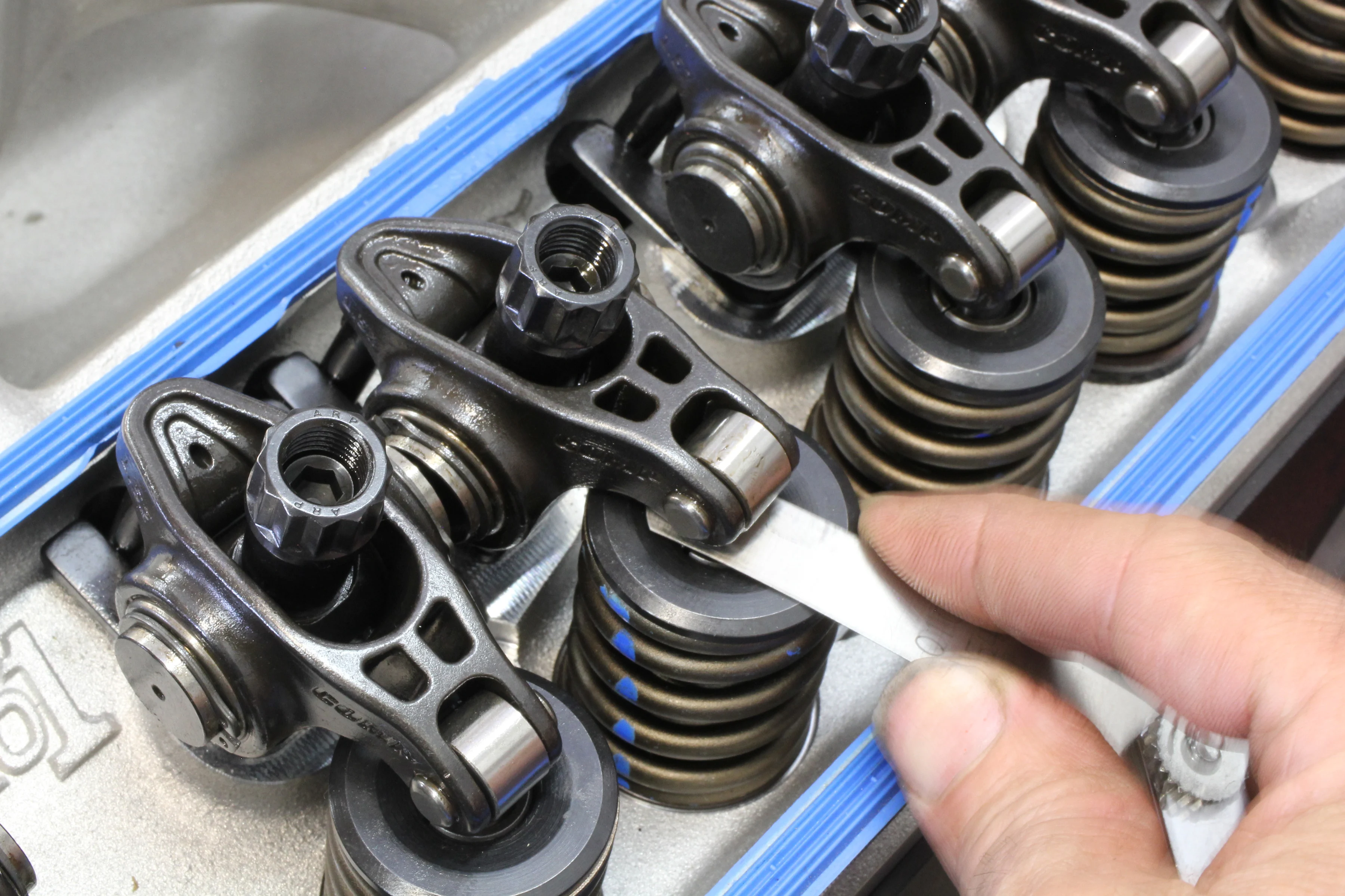
Slide the feeler gauge between the rocker and valve stem
Compare the drag to spec
Adjust as needed
Recheck after torquing the locknut or installing a shim
Move through the firing order
Short strokes. Slow movements. No guessing.
Used on many older Ford, CAT, and medium-duty diesels.
Steps:
Back off the locknut
Turn the adjuster until the gauge slides with light, even drag
Hold the adjuster steady and torque the locknut
Recheck to confirm it didn’t move
Clean and reliable.
Common on Duramax, Cummins ISB/ISX variants, and imported diesels.
Process:
Depress the bucket or remove the camshaft
Measure existing shim thickness
Calculate the needed replacement
Install the new shim and verify the gap
More work, more precision. Patience saves money.
Manufacturers set the baseline, but diesel reality adds nuance:
100,000 miles is the most common interval
500–1,000 hours on stationary or equipment engines
High-load work (fleets, towing) benefits from shorter cycles
Any head or camshaft work requires a lash reset
If a diesel sounds different, idles different, or cranks longer—it’s time.
DIY: $70–$200 in tools and supplies
Professional shop: $300–$800+ depending on access
Compared with a burnt exhaust valve, lash adjustment is cheap insurance.
Diesel engines depend on full sealing at high heat and extreme cylinder pressures.
Too tight burns valves. Too loose damages the valvetrain. There’s no “close enough.”
If it uses a screw-and-locknut setup and you’re mechanically confident—yes.
Shim systems? Most techs prefer to handle those.
Almost always cold.
Hot adjustments are rare and model-specific—follow the manual.
Loose? Maybe short-term.
Tight? No. You’re driving toward a burnt valve.
You’ll see:
Lost fuel economy
Weak power
Excess smoke
Burnt valves
Broken valvetrain components
The engine always pays the bill.