In the bay, spark plugs don’t fail quietly. When a plug starts to weaken, the engine doesn’t wait for a warning light to complain. It shows it in how it starts, idles, and pulls under load.
A spark plug’s job is simple: light the mixture, every time, under pressure. Once that spark weakens, combustion loses timing and consistency. That’s when driveability issues start stacking up. Miss one early sign, and the problem spreads beyond the plug itself.
This article focuses on what bad spark plug symptoms look like in real driving and, more importantly, when those symptoms actually point to the spark plug and not something else.
In the field, spark plug failures usually follow the same patterns.
Electrodes round off after thousands of heat cycles. As the gap grows, the ignition system has to work harder to fire the plug. Under load, that extra demand shows up fast.
Rich mixtures, frequent short trips, or incomplete combustion leave carbon deposits on the plug tip. Carbon insulates the electrode, weakening the spark before it disappears.
Oil entering the combustion chamber coats the plug and contaminates the insulator. Once oil fouling starts, spark quality drops sharply and rarely recovers.
Incorrect heat range, improper gap, poor fuel quality, or cooling system problems push plug temperatures too high. Overheated plugs erode quickly and put extra strain on the ignition coil.
Wrong torque or an incorrect plug type shortens service life immediately. Many early plug failures trace back to installation errors rather than the part itself.
What it feels like: hesitation, bucking, or sudden power loss, especially during acceleration.
What’s happening: the spark can’t consistently jump the gap under cylinder pressure. One missed ignition turns into repeated misfires as load increases.
When to suspect spark plugs first: misfires appear mainly under load, no injector or compression faults are present, and the coil shows no obvious failure but is working harder than normal.
When it may not be the plug: misfires occur randomly across multiple cylinders or are paired with fuel pressure or injector codes.
Left unchecked, plug-related misfires overwork the ignition coil and overheat the catalytic converter.
What it looks like: extended cranking or multiple start attempts, often worse on cold mornings.
What’s happening: weak spark struggles to ignite cold, poorly atomized fuel. The engine cranks normally, but combustion doesn’t catch right away.
When to suspect spark plugs: cranking speed is normal, the battery tests good, and starting improves once the engine warms up.
When to look elsewhere: slow cranking or a complete lack of spark across multiple cylinders.
Cold-start complaints with normal cranking often lead back to worn plugs in real-world diagnostics.
What drivers notice: more frequent fuel stops and shorter range without a change in driving habits.
What’s happening: incomplete combustion leaves unburned fuel in the cylinder. The ECU compensates by adding fuel, masking the problem while worsening consumption.
When plugs are likely: fuel trims climb with no sensor faults or vacuum leaks, and driveability complaints appear alongside the mileage drop.
This symptom is often overlooked until fuel costs make it impossible to ignore.
What it feels like: flat acceleration, delayed response, and more pedal needed to pass or merge.
What’s happening: weak ignition reduces effective cylinder pressure. Torque drops before any warning light appears.
When plugs are the prime suspect: power loss worsens under load, with no transmission issues, airflow restrictions, or fuel delivery problems.
Drivers often describe this as the engine feeling heavy or lazy.
What you hear and feel: shaking at idle, fluctuating RPM, or an uneven exhaust note.
What’s happening: inconsistent ignition timing shows up most clearly at low speed, where the engine has no momentum to smooth things out.
When spark plugs are likely: vibration is isolated to one cylinder, idle improves slightly with RPM, and no vacuum leaks are present.
Persistent rough idle is often an early warning sign of plug failure.
What shows up: strong fuel odor from the exhaust, darker emissions, or a failed inspection.
What’s happening: unburned fuel exits the cylinder and overloads the catalytic converter.
When to check plugs immediately: emissions failure occurs without sensor faults, or fuel smell appears alongside misfires.
Many catalytic failures start with ignored ignition problems.
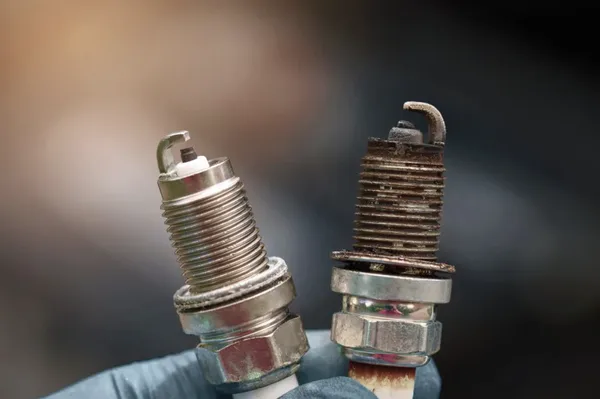
Carbon buildup appears as black deposits around the electrode. Oil fouling leaves oily residue on the insulator or tip. Worn electrodes show rounded edges and excessive gap growth. Any cracked ceramic insulator means the plug is done.
Once these signs appear, the plug has passed its reliable service window.
Misfire codes that follow a specific cylinder and rising ignition voltage demand are strong indicators of plug failure. In practice, visual inspection combined with live data usually confirms the diagnosis quickly.
Most spark plugs last between 30,000 and 80,000 miles, depending on plug type, engine design, and operating conditions. Short trips, rich mixtures, and heavy loads shorten service life.
OEM or equivalent-quality plugs matched to the engine help prevent repeat failures. Installation matters just as much as the part itself. Incorrect torque or gap stresses ignition coils and leads to comebacks. Many ignition problems return not because the plug was bad, but because it was installed incorrectly.
How often should spark plugs be replaced?
Most spark plugs last between 30,000 and 80,000 miles, depending on plug type, engine design, and driving conditions. Short trips, rich mixtures, and heavy loads shorten service life. Follow the manufacturer’s interval, but replace earlier if misfires, rough idle, or hard starts appear.
Can bad spark plugs trigger the check engine light?
Yes. When spark plugs misfire, the ECU detects irregular combustion and may trigger or flash the check engine light. A flashing light usually indicates active misfires that can quickly damage the catalytic converter, making ignition issues a high-priority repair.
Do bad spark plugs affect fuel economy?
Yes. Weak or inconsistent spark causes incomplete combustion, forcing the ECU to add fuel to maintain power. Over time, this increases fuel consumption and operating costs, often without immediately triggering a warning light.
Can failing spark plugs damage other components?
Prolonged misfires strain ignition coils and overload the catalytic converter with unburned fuel. If ignored, a simple spark plug issue can escalate into coil failure or expensive exhaust and emissions repairs.
How can I tell if spark plugs are bad without removing them?
Common signs include hard starts, rough idle, misfires under load, sluggish acceleration, increased fuel consumption, and fuel smell from the exhaust. If these symptoms appear without battery or fuel pressure issues, spark plugs should be checked early.
In the field, most expensive ignition repairs start with small, ignored symptoms. Weak plugs strain coils. Misfires overload catalysts. The engine compensates until something fails.
Reliable ignition comes down to pattern recognition and part quality. Using system-matched, durable components reduces comebacks and keeps engines predictable. Manufacturers like SUMATE focus on consistency and durability for exactly this reason.
Catch spark plug problems early, and the fix stays simple. Ignore them, and the repair list grows fast.