Facebook

WELCOME TO OUR BLOG

We're sharing knowledge in the areas which fascinate us the most
click

What Are the Advantages and Disadvantages of a CVT Transmission

By Lucas January 20th, 2026 249 views

CVT Transmissions: Why So Many Modern Cars Use Them

In today’s vehicles, transmissions are no longer judged only by how they shift, but by how efficiently they manage load, heat, and durability over time. That shift in priorities is exactly why CVT transmissions became so common.

A CVT, or Continuously Variable Transmission, removes fixed gear steps and keeps the engine operating in its most efficient range. On paper, it solves fuel economy and drivability problems. In the shop, though, CVTs tend to divide opinion. They work very well in certain conditions and break down quickly in others. The difference comes down to system limits, not marketing claims.

What a CVT Transmission Actually Is — and How It Differs From Gears

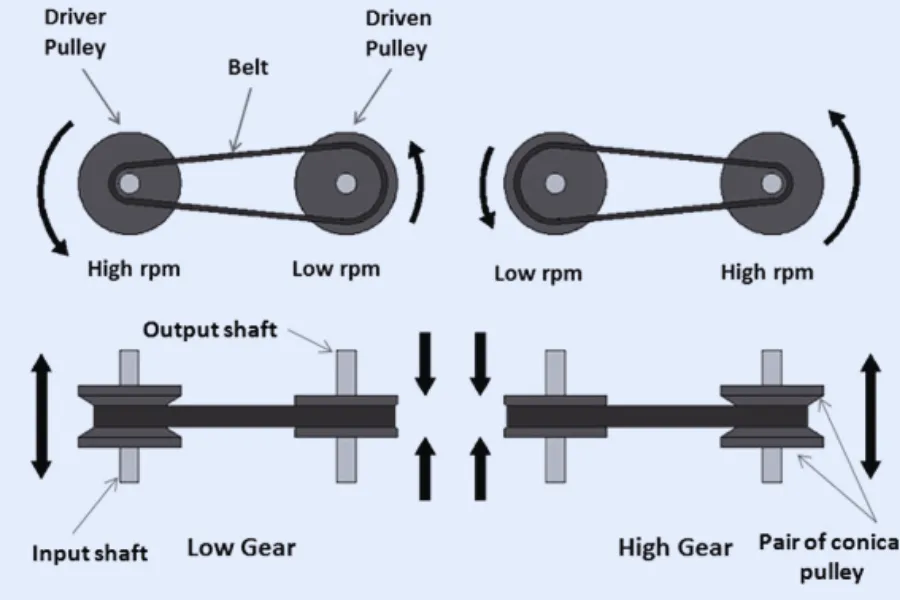
Diagram of CVT components showing how pulleys and belt adjust ratios – What Are the Advantages and Disadvantages of a CVT Transmission


The Core Hardware: Pulleys, Belt, and No Fixed Gears

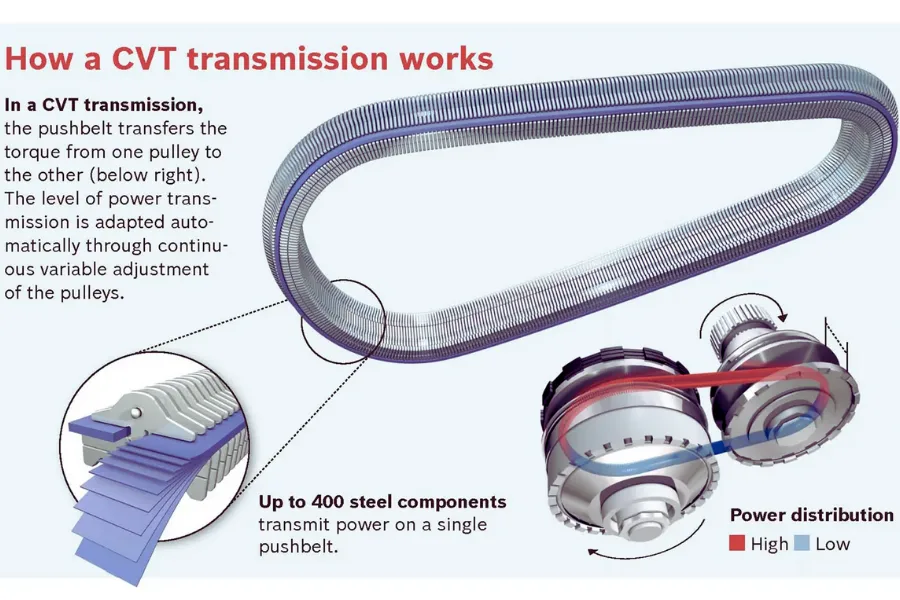
A CVT transmission replaces traditional gearsets with two variable-diameter pulleys connected by a steel belt or chain. Instead of engaging gears, the system changes pulley width to alter the drive ratio. There are no fixed steps, and the transmission never “shifts” in the traditional sense.

Diagram explaining how a CVT transmission works and showing the advantages and disadvantages of a CVT transmission design

How a CVT Changes Ratios Without Shifting

One pulley is connected to the engine, the other to the drivetrain. Hydraulic pressure forces the pulleys to open or close as load and speed change. The belt rides higher or lower on each pulley, continuously adjusting the ratio.

Because there are no shift events, the system is always under load. Belt tension, pulley pressure, fluid condition, and cooling all matter all the time—not just during gear changes.

Why CVTs Took So Long to Catch On

The CVT concept has existed for centuries, but early materials couldn’t survive sustained automotive loads. Modern metallurgy, electronic controls, and fluid management finally made CVTs practical, especially once fuel economy and emissions became design priorities.

Where CVT Transmissions Work Well

Why CVTs Save Fuel in Daily Driving

CVTs perform best in light-to-moderate load conditions. By keeping engine RPM in the optimal efficiency range, they avoid the energy losses that come with repeated upshifts and downshifts. In city traffic and steady highway cruising, fuel economy typically improves by 10–15% compared to conventional automatics. For commuters and fleets watching operating costs, this advantage is measurable.

Why CVTs Feel Smooth in Traffic and on Hills

Without fixed gear changes, CVTs eliminate shift shock and gear hunting. Acceleration feels linear, and power delivery on hills stays consistent. In stop-and-go traffic, that smoothness reduces driver fatigue and customer complaints about harsh shifting.

Fewer Parts, Less Weight — and Why That Matters

CVTs use fewer mechanical components than multi-speed automatics. Reduced weight improves efficiency and makes packaging easier, which is why CVTs are commonly paired with small-displacement engines and hybrid drivetrains. Lower rotating mass also reduces parasitic losses, supporting overall system efficiency.

How CVTs Adjust Instantly to Changing Conditions

Because ratios are continuous, CVTs respond immediately to changes in throttle input and road load. There’s no delay waiting for a downshift. In light-duty use—urban driving, mild grades, steady cruising—this responsiveness works exactly as intended.

Where CVT Transmissions Fall Short

Why CVTs Tend to Wear Out Sooner

CVT durability problems are not caused by a single weak component. They come from constant tension and heat. As torque rises, belt clamping pressure increases sharply, contact stress between the belt and pulleys rises, and heat builds faster than in stepped gear systems.

Unlike traditional automatics, CVTs never get a break between shifts. Continuous adjustment means continuous wear, which is why average service life often lands around 100,000 miles, well below many conventional automatics.

Why CVT Repairs Get Expensive Fast

Once internal wear begins, repair options narrow quickly. In real-world service, many CVTs are not rebuilt—they are replaced. Specialized components, precise calibration, and contamination risk push repair costs higher and reduce turnaround options. For fleets and service counters, CVT failures often become cost-and-downtime decisions, not just mechanical ones.

Why Some Drivers Don’t Like the Way CVTs Feel

The lack of shift feedback creates the familiar “rubber band” sensation. Engine RPM rises quickly, while vehicle speed follows more gradually. Even when operating normally, this disconnect feels wrong to drivers accustomed to stepped transmissions. Some manufacturers simulate shifts to address perception, not mechanical limitation.

The “Rubber Band” Sound and Other Common Complaints

High, steady RPM under acceleration often triggers noise complaints. The challenge is that noise alone does not equal failure. This creates diagnostic gray zones where the transmission sounds unhealthy but still operates within specification—an uncomfortable position for both technicians and customers.

Why CVTs Struggle With High Torque and Hard Driving

High torque changes everything. Under towing, aggressive acceleration, or long uphill grades, the system follows a predictable chain reaction: torque raises belt pressure, friction increases heat, CVT fluid thins, hydraulic response slows, and wear accelerates.

That’s why CVTs are a poor fit for sustained heavy-duty use. They were never designed for long-term high-stress cycles.

CVT vs. Traditional Automatics: Which One Fits Your Driving?

Category CVT Transmission Traditional Automatic
Fuel Efficiency Strong Moderate
Shift Feel Seamless Defined
Durability Under Load Limited Strong
Repair Approach Often replace Repairable
Best Use Commuting, hybrids Towing, performance

How CVT Designs Are Improving — and Their Limits

What Manufacturers Are Fixing — and What They Can’t

Modern CVTs use improved belt materials, better cooling strategies, and launch gears to reduce low-speed stress. These updates help, but they don’t change the core reality: CVTs still rely on friction and hydraulic control under constant load.

Long-term reliability depends heavily on system matching—using components designed to work together over time, not just meet minimum specs. This is where durability-focused suppliers like SUMATE support stable drivetrain performance by prioritizing consistency and longevity over short-term cost savings.

Why CVTs Keep Showing Up in Hybrids

Hybrid systems control torque delivery more carefully, keeping CVTs within their ideal operating window. Reduced stress and predictable load profiles allow efficiency benefits to outweigh durability concerns, which explains CVTs’ continued presence in hybrid platforms.

FAQ

Which vehicles typically use CVT transmissions?
CVT transmissions are most commonly used in Toyota, Honda, Subaru, and Nissan vehicles, particularly in hybrids, compact SUVs, and economy-focused sedans. These platforms emphasize fuel efficiency and smooth drivability rather than high torque output, which aligns well with how CVT systems are engineered to operate long term.

What maintenance matters most for CVTs?
Correct CVT-specific fluid and proper service intervals are critical. CVTs depend heavily on fluid condition to manage heat, belt pressure, and hydraulic response. Skipping fluid services, using incorrect fluids, or operating under sustained high load can accelerate internal wear and significantly reduce transmission lifespan.

Is a CVT transmission good for long-distance or highway driving?
Yes. CVTs perform well during steady highway driving because they maintain low engine RPM and avoid unnecessary ratio changes. This reduces heat buildup and improves fuel efficiency. Long-distance driving is generally low stress for CVTs, provided towing and aggressive acceleration are avoided.

Is CVT noise always a sign of a problem?
Not always. CVTs often produce a steady, higher-pitched engine sound during acceleration, which can feel unusual but still be normal. However, sudden changes in noise, vibration, or drivability—especially when occurring together—should be inspected, as they may indicate belt slip or hydraulic issues.

Can CVTs handle towing or off-road use?
Most CVTs are not designed for sustained high-torque applications such as towing or off-road driving. Heavy load quickly increases belt pressure and heat, accelerating wear. For frequent towing or demanding terrain, traditional automatic or heavy-duty transmissions are generally a more reliable choice.

Which transmission lasts longer—CVT or automatic?
Traditional automatic transmissions typically last longer under varied and heavy-use conditions. CVTs are more sensitive to heat and load due to constant belt tension. With proper maintenance and moderate driving, CVTs can be reliable, but they are less forgiving under high-stress operation.

Final Take: When a CVT Makes Sense — and When It Doesn’t

CVTs do exactly what they were designed to do: improve efficiency and smoothness in everyday driving. In controlled conditions, they deliver real fuel savings and consistent drivability.

But they demand realistic expectations. High torque, heat, and sustained load expose their limits quickly. Long-term reliability depends on proper application, disciplined maintenance, and components engineered for durability. In that context, experienced judgment and quality-focused suppliers such as SUMATE help keep vehicles out of the comeback lane and on the road where they belong.

What is the normal engine oil temperature shown on a vehicle oil temperature gauge
Previous
What Is the Normal Engine Oil Temperature?
Read More
Struts vs Shocks comparison showing suspension components in vehicle suspension system
Next
Struts vs. Shocks: What's the Difference
Read More